
How would you design a distributed job scheduling system like Cron at scale
What would you do if you had to design Cron — but for millions of jobs, across multiple servers, at global scale?

Hello “👋
Welcome to another week, another opportunity to become a Great Backend Engineer.
Today’s issue is brought to you by Masteringbackend → An all-in-one platform that helps backend engineers become highly-paid backend and AI engineers by leveraging a practical-based learning approach.
Welcome to another issue of Backend Weekly — your favorite newsletter on mastering backend engineering through real-world systems and interview design questions.
Before we dive in:
We recently moved Backend Weekly from Beehiiv to Substack!
You don’t have to do anything — same great weekly content, just a new home.
Welcome to the interview series on Backend Weekly.
In this series, I will walk you through how to answer common backend engineering interview questions ranging from different backend engineering concepts like system design, microservices, database, etc.
Let’s get started with episode 1:
The Interview Scenario
You’re in a backend interview.
They ask:
“How would you design a distributed job scheduling system like Cron but at scale?”
Here’s how to approach it:
Understand the Problem
The first step towards solving any problem is understanding the problem inside and out.
Let’s break down the problem:
A cron service works great when you’re on a single machine. However, what if you’re running millions of jobs, recurring or one-time, across hundreds of servers, regions, and tenants.
Below are some of the problems you will have to worry about:
Jobs running exactly once at the correct time.
No duplication or missed executions
Scalability and handling spikes in scheduled jobs.
Fault tolerance: What happens when a node dies mid execution.
When you take these problems (and more) into consideration, you’re no longer designing a single simple Cron service.
The High-Level Architecture
Now that we understand the challenges of building a distributed Cron system, let’s visualize the architecture.
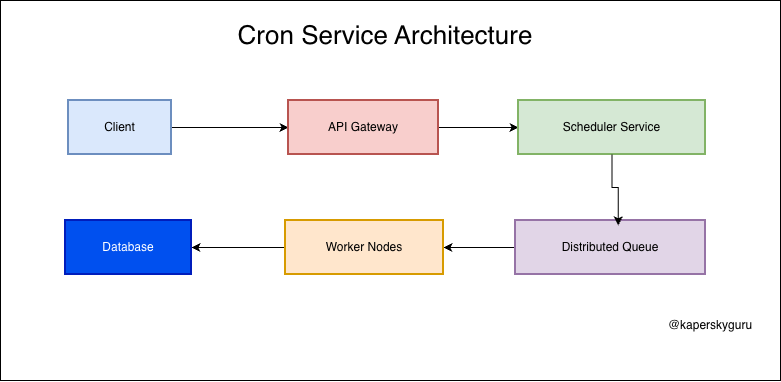
Here’s how each part fits and what it does:
Client/API Gateway: This is where the jobs are created, updated, and deleted via API or UI.
Job Service: The job service stores the job definitions and metadata such as interval, next run time, owner, payload, etc.
Scheduler Service: The scheduler service continuously checks which jobs are due and dispatches them for execution.
Distributed Queue (Kafka, RabbitMQ, SQS): This buffers and distributes jobs to available workers.
Worker Nodes: The worker node executes the actual jobs either by running a script, making HTTP calls, or performing database operations and report results.
Database: The database is used to persist job definitions, execution history, and audit logs.
Scheduling Logic
Now let’s talk about how jobs are actually triggered.
All jobs are stored in the database with metadata like:
job_id, interval, next_run_at, owner, statusStoring the metadata for each job is the function of the Job Service we mentioned before.
The scheduler periodically polls the database for jobs due to run and does the following:
It pushed the task to the distributed queue.
Workers consume from the queue and execute.
Results and timestamps are written back to the database.
Let’s visualize this process:
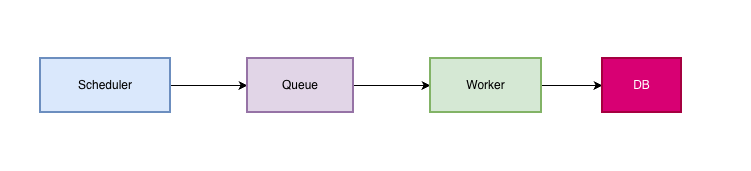
The scheduling logic looks simple right? But things can get tricky when it becomes distributed.
Now that the scheduling logic is out. Let’s look at some challenges we might face when dealing with millions of users.
The Challenges
Let’s explore some of the challenges and how to solve them:
1. Avoiding Duplicate Runs
Let’s consider what happens when you have multiple scheduler nodes running.
Each node might poll the same database table and try to execute the same job simultaneously. That will cause duplicated jobs to execute which is a big NO for a scheduling service.
Here’s a quick solution to solve duplicates:
Distributed Locks (Redis lock): Before executing, each scheduler node tries to acquire a Redis lock for the job, and only the node that acquired the lock proceeds.
Database Row Locks: Use transactional row-level locking when updating
`next_run_at`or`status`.Consistent Hashing: Assign each job to a specific scheduler node based on a hash of its ID to avoid overlap entirely.
Timestamps: Track `last_executed_at` to prevent re-runs.
Avoiding duplicates in a scheduling service is one of the core challenges to tackle. Therefore, now that we have solved that. Let’s see how we can scale the system to handle millions.
2. Scaling the System
When you’re handling millions of jobs, even a single scheduler won’t cut it.
Therefore, you can explore the following scalability options:
Partitioning jobs: You can partition jobs by user, tenant, or time window.
Sharding queues: Where each scheduler writes to its own queue partition.
Leader election: You can use Zookeeper or etcd to coordinate active schedulers.
Auto-scaling workers: You can scale each worker independently.

Now your system can elastically scale based on load. However, the system can still break, and that’s inevitable. So, how do we tackle this so the scheduling service does not crash?
3. Fault Tolerance
It is general knowledge that sometimes, distributed system fails, and that’s inevitable.
Therefore, the interviewer will expect that your system is designed for fault tolerance and to gracefully recover from failures.
Let’s look at how to achieve fault tolerance in our system:
Worker Node Crashes: When designing your worker node, make sure it uses ack/nack so that if a worker dies mid-task, the job is re-queued for another worker.
Scheduler Fails or Restarts: Design your schedulers to be stateless, so you can restart each scheduler freely.
Persistence: Every job’s lifecycle (created, scheduled, executed, failed, retried) is stored in the DB for audit and replay.
Designing your system to gracefully recover from failures is the best thing to do when building for millions. However, the next best thing is to observe when something is wrong and what caused it.
4. Observability & Management
While designing this system and answering your interviewer’s question, you need to understand that your scheduler service is not only about execution but also visibility.
You will need to have monitoring and observability in place to constantly learning about the service and where to improve or fix bugs.
You will need to set the following up:
APIs and dashboards to check job status, next runs, and logs.
Metrics:
Job latency
Success/failure rates
Queue depth
Worker throughput
Retries with exponential backoff for transient failures.
This helps SREs and developers trust the system. Solving all these challenges will put your scheduling service in a position to handle millions of users. However, we can still optimize further.
Optimization Tricks
Now that the core of the system is out, you can start making it smarter.
Let’s explore some optimization tricks that you can add or discuss with your interviewer to give you an upper hand in the interview.
Priority Queues: Urgent jobs get scheduled first.
Redis Cache: Cache active or hot jobs to reduce DB polling.
Batching: Combine small periodic jobs into one batch job to save resources.
Adaptive Polling: Dynamically adjust the scheduler’s polling interval based on system load.
Final Answer
Here’s exactly how to put your answer forward to the interviewer:
“I will design a distributed, fault-tolerant job scheduling system with a central job database, horizontally scaled schedulers using Redis locks for deduplication, a distributed queue for task dispatching, and stateless workers for execution — observable, elastic, and cloud-ready.”

Closing Thoughts
Designing something as simple as “cron at scale” teaches you nearly every backend concept that matters:
Distributed locking
Leader election
Message queues
Fault tolerance
Observability
Scalability
It’s a masterclass in system design thinking.
So next time an interviewer asks you this question in an interview — don’t just say “I’ll use a queue.”
Walk them through why and how you’d make it reliable, scalable, and production-grade.
I hope you learned something today: Spread the love. Share this newsletter with at least two of your friends today.
Also, let me know if you enjoy this new series and if you want me to continue breaking down interview questions like this.
Remember to start learning backend engineering from our courses:
Get a 50% discount on any of these courses. Reach out to me (Reply to this mail)
Backend Engineering Resources
Whenever you’re ready
There are 4 ways I can help you become a great backend engineer:
1. The MB Platform: Join 1000+ backend engineers learning backend engineering on the MB platform. Build real-world backend projects, track your learnings and set schedules, learn from expert-vetted courses and roadmaps, and solve backend engineering tasks, exercises, and challenges.
2. The MB Academy: The “MB Academy” is a 6-month intensive Advanced Backend Engineering BootCamp to produce great backend engineers.
3. MB Video-Based Courses: Join 1000+ backend engineers who learn from our meticulously crafted courses designed to empower you with the knowledge and skills you need to excel in backend development.
4. GetBackendJobs: Access 1000+ tailored backend engineering jobs, manage and track all your job applications, create a job streak, and never miss applying. Lastly, you can hire backend engineers anywhere in the world.
LAST WORD 👋
How am I doing?
I love hearing from readers, and I’m always looking for feedback. How am I doing with The Backend Weekly? Is there anything you’d like to see more or less of? Which aspects of the newsletter do you enjoy the most?
Hit reply and say hello - I’d love to hear from you!
Stay awesome,
Solomon